
Touch Technology Selection for Military Applications: Capacitive vs. Resistive in 2025
Touchscreen technology selection for military applications requires careful evaluation of competing technologies, balancing usability, durability, and operational requirements. Capacitive touch dominates consumer electronics through superior sensitivity and multi-touch capability but faces significant challenges in military environments. Resistive touch offers advantages for gloved operation and exposure to harsh conditions but sacrifices responsiveness and multi-touch support. In 2025, technology maturation enables informed selection based on application-specific requirements rather than consumer defaults.
Technical Considerations and Implementation
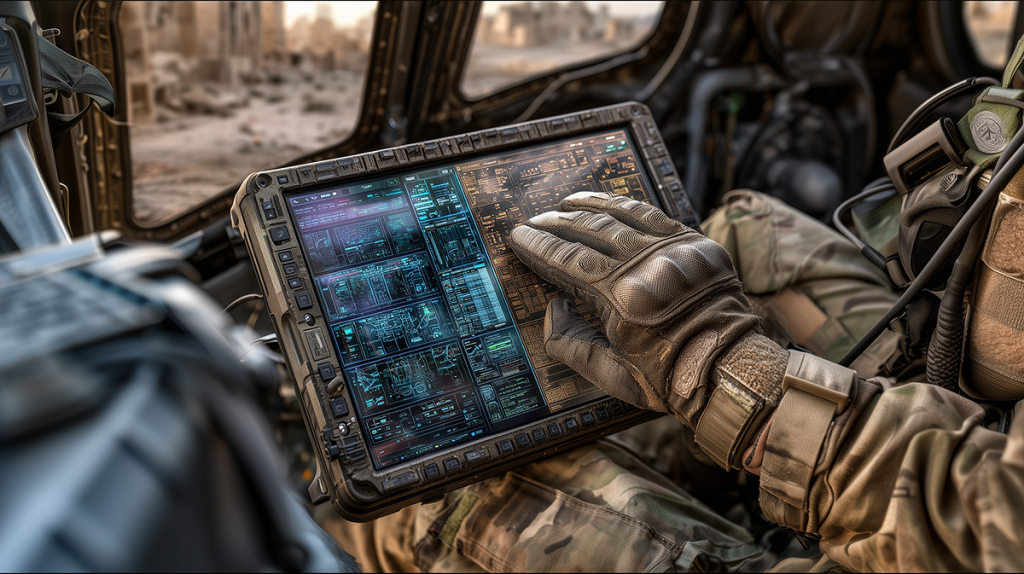
Projected capacitive (PCAP) panels detect finger position by sensing disturbances in an electrostatic field near the screen surface. This approach enables highly responsive multi-touch input with excellent optical clarity, but the technology requires a conductive object – typically bare skin or a special stylus – to register input. Standard military and flight gloves fail to trigger conventional PCAP sensors reliably, though advanced glove-mode tuning in modern controllers has partially bridged this gap. Performance under gloved use remains inconsistent across glove materials, thickness, and operating temperatures.
Resistive panels operate through physical pressure: two conductive layers make contact when the surface is depressed, completing an electrical circuit. The technology responds to any input – gloves, styluses, or blunt objects – making it inherently suited to mission environments. Trade-offs include lower optical clarity from the dual-layer construction, reduced durability under heavy sustained use, and the absence of multi-touch capability in standard implementations.
Environmental performance is a critical differentiator. Resistive panels, when properly sealed, resist false activation from water droplets, condensation, and conductive particulates. Capacitive surfaces are vulnerable to these triggers, causing spurious inputs aboard ship, in rotorcraft wash-down environments, or during sandstorm conditions. Both technologies must meet MIL-STD-810 environmental requirements, and MIL-STD-461 electromagnetic compatibility testing is mandatory for cockpit and vehicle applications where interference from avionics, radar, and communication systems can degrade touch sensor performance.
Display integration adds complexity. Touch overlays mounted on sunlight-readable displays must balance anti-reflection coating performance with mechanical durability. Bonded-lens construction – eliminating the air gap between touch panel and display – reduces parallax, improves contrast in high-ambient-light conditions, and prevents moisture ingress, but adds manufacturing cost and complicates field replacement.
Industry Best Practices
Leading military display integrators recommend application-specific testing using representative glove types, contamination scenarios, and temperature extremes rather than relying on published specifications alone. Laboratory simulations of operational conditions consistently reveal performance gaps that datasheet comparisons miss.
Hybrid configurations are gaining adoption in 2025. Advanced ruggedized displays offer selectable touch modes – switching between high-sensitivity capacitive operation for bare-finger use and pressure-based compatibility for gloved environments. This flexibility avoids committing to a single technology during the platform design phase and extends platform relevance as mission profiles evolve.
Obsolescence planning is essential for programs with 15- to 20-year service lives. Resistive technology, while proven, receives declining commercial investment as consumer electronics move entirely to capacitive solutions. Procurement specialists should verify supplier long-term production commitments or qualify alternative assemblies during initial design to mitigate future supply chain risk.
Conclusion
Selecting the right touch technology for military applications demands rigorous evaluation of gloved usability, environmental resilience, display integration, and long-term supportability – no single technology suits every platform or mission. AEROMAOZ provides ruggedized touchscreen solutions engineered for military and commercial aviation, armored vehicle, naval, and UAV applications, supporting system integrators and platform manufacturers from technology selection through full lifecycle sustainment.