
What Makes a Modern Military Display?
The Defining Characteristics of Defense-Grade Screens
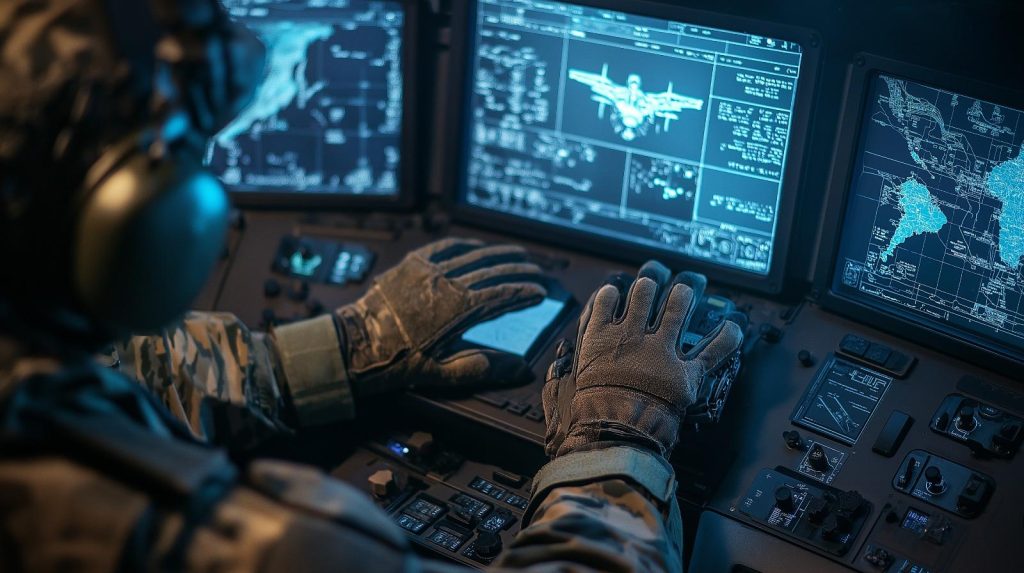
In environments where a fraction of a second determines a mission’s outcome, the military display is far more than a screen. Every sensor feed, system status, and tactical picture the operator will ever see must pass through it – making it the single most consequential interface on the platform. Yet not every product that carries the label deserves it. The gap between a genuine defense-grade panel and a hardened commercial screen is wide, and specifying the wrong solution carries operational risk that propagates through the entire platform lifecycle.
Clarity Where It Counts: Optical Performance
The most visible differentiator of a true military display is luminance. Sunlight glare, desert reflections, and open hatches in direct sun render conventional screens unreadable. Defense-grade panels deliver 1,500–3,000 nits sustained for cockpit applications, rising beyond 5,000 nits for open-deck naval and vehicle-mounted use. Optical bonding eliminates the internal air gap that traps reflections, measurably improving contrast ratios and reducing operator eye fatigue. Precision anti-reflective coatings and automatic luminance control complete the picture.
Built to Survive: Environmental Ruggedization
A display must perform identically after storage at -55 °C, transport at altitude, operation in blowing sand, and cleaning with chemical decontamination agents. MIL-STD-810H covers more than thirty test methods; IP67 or IP68 sealing is a baseline requirement, not a premium option. For armored vehicle and naval programs, gun-blast overpressure and shipboard shock add test axes that commercial ruggedization programs never encounter. Suppliers who have completed these qualifications carry the evidence — those who have not are asking the integrator to absorb the risk.
Owning the Night: NVIS Compatibility
NVIS compatibility is non-negotiable for any military display used in cockpits where crews wear night-vision goggles. Unfiltered LED backlights emit strongly in the 625–930 nm near-infrared band that Gen III intensifier tubes amplify, causing NVG wash-out at the worst possible moment. MIL-L-85762A Class A and B define the radiance limits — but compliance must be validated across the full temperature range, since LED emission spectra shift at cold extremes. Programs transitioning to the US Army’s ENVG-B system face stricter requirements than those qualified only against legacy AN/AVS-6 or AN/AVS-9 goggles. Learn more on our military aviation solutions page.
Silent and Shielded: EMI/EMC Performance
A military display operates inside some of the most electromagnetically intense environments on earth — active radar suites, HF communications systems, and multi-emitter warships. Meeting MIL-STD-461G and DO-160G Section 21 requires far more than conductive gaskets added at production. EMI performance is inseparable from original mechanical design: an unbroken Faraday cage, filtered power and signal lines, and driver ICs clocked to keep harmonics away from critical navigation bands such as GPS L1. Programs that exclude the display supplier from early integration design reviews routinely discover EMC gaps at system test — an expensive problem that is fully avoidable.
Command at a Touch: Gloved Interfaces
Combat gloves, flight gloves, and NBC gear eliminate the conductivity that standard capacitive sensors require — turning a touchscreen into a useless pane of glass the moment gloves go on. Solutions in current programs include high-sensitivity projected capacitive overlays tuned to glove materials, glove-agnostic resistive overlays, and hybrid designs that pair touchscreens with physical rotary encoders and function keys for eyes-off operations. For UAV ground control stations and flight simulators, large-format multi-touch enables gesture-based map interaction and concurrent multi-sensor management that reduces single-operator cognitive workload significantly.
Designed for Decades: Service Life and Obsolescence Management
A military display decision made today will shape platform capability into the 2040s. Genuine long-service-life design means LED backlights with MTBF exceeding 50,000 hours, component selection that avoids end-of-life parts within the projected service window, and modular construction allowing backlight, touch overlay, and processing module to be replaced independently. The most underrated supplier differentiator — and one procurement teams should demand documentation on before shortlisting — is a credible Diminishing Manufacturing Sources management plan. Field return data from comparable in-service programs is far more meaningful than a calculated MTBF figure on a datasheet.
Open, Modular, and Future-Ready: Architecture Standards
The FACE™ Technical Standard, the US Army’s VICTORY architecture, and the UK MOD’s Generic Vehicle Architecture all mandate standardized display subsystem interfaces — preventing vendor lock-in and enabling best-of-breed component refresh across the platform lifecycle. For display manufacturers, this means standardized form factors, COTS GPU-based graphics processing modules with published interface specifications, and avionics software certified to DO-178C DAL B or higher. For tier-1 system integrators and platform primes, open architecture compliance has moved from a desirable feature to a gate requirement. Suppliers who cannot demonstrate it are excluded before technical evaluation begins.
The Proof Is in the Program: Qualification Pedigree
Every characteristic above can be claimed in a datasheet. The question that separates suppliers is whether they can prove it. When evaluating a military display supplier, request in-service program references with platform type, part number, entry-into-service date, and fleet size. Establish whether the supplier is the original designer and manufacturer of the optics and electronics, or an assembler of third-party components — program support and obsolescence management are qualitatively different between those two models. In military aviation programs subject to type certification, a supplier with a mature change management process shortens every qualification cycle; one without that capability extends it, at the program’s expense.
AEROMAOZ (www.aeromaoz.com) is a world-recognized designer and manufacturer of rugged Human-Machine Interface solutions for mission-critical platforms. With over 40 years of experience spanning military and commercial aviation, armored vehicles, UAVs, flight simulators, and naval platforms, AEROMAOZ brings the qualification depth, in-service track record, and cross-disciplinary engineering expertise that each of these characteristics demands.