
NVIS Compatibility in 2025: Balancing Readability, Safety, and Covert Operations
In the darkness of contested airspace, military pilots navigate where the slightest cockpit illumination could compromise mission success or crew survival. Night Vision Imaging Systems (NVIS) technology has evolved from tactical advantage to operational necessity, but achieving true NVIS compatibility remains one of the most technically demanding challenges in avionics design. Understanding the nuances of MIL-STD-3009 and balancing competing requirements for visibility, safety, and operational security has never been more critical.
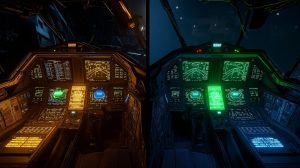
Understanding MIL-STD-3009: The Foundation of NVIS Design
MIL-STD-3009, which superseded MIL-L-85762A in 2001, establishes emission requirements for aircraft lighting compatible with night vision goggles (NVGs). The standard addresses a fundamental challenge: cockpit instruments must be clearly visible to the unaided eye while producing minimal emissions in wavelengths that interfere with NVGs or reveal aircraft position. The standard defines three NVIS classes based on objective lens filter characteristics:
Class A NVIS employs a 625nm minus-blue filter, the most restrictive specification. Class A systems prohibit red cockpit lighting as red wavelengths overlap with the NVG response band, designed for maximum covert operation capability.
Class B NVIS utilizes a 665nm objective lens filter with slightly relaxed restrictions permitting limited red lighting. Class B represents the most common specification for military cockpits, offering practical balance between operational flexibility and NVIS performance.
Class C NVIS, known as “leaky green,” features a notched spectral response allowing very specific red wavelengths, primarily for head-up display (HUD) applications where HUD symbols must remain visible through NVGs.
The Science of NVIS Radiance and Chromaticity
Achieving NVIS compatibility requires precise control of spectral radiance and chromaticity. Spectral radiance, measured in mW/cm², determines light energy entering NVG sensors. MIL-STD-3009 establishes maximum NVIS radiance (NRa and NRb) values by weighting spectral measurements against NVG filter response. IR emissions must fall below the lowest outside night sky radiation source to avoid interfering with the amplified image.
Chromaticity defines color quality and purity. MIL-STD-3009 specifies exact chromaticity coordinates in the CIE 1976 color space for six colors: NVIS Green A, NVIS Green B, NVIS Yellow, NVIS Red, and NVIS White. These standardized colors ensure lighting consistency across all applications. NVIS White, despite its greenish tint, provides full-spectrum illumination combining blue through green wavelengths while remaining outside the NVG response band.
Dimming Capabilities: From Full Brightness to Covert Operations
Modern military operations demand unprecedented cockpit lighting control. During daylight, displays must achieve sunlight readability exceeding 1000 cd/m². During covert nighttime operations, systems must dim to less than 1 nit to prevent light spill.
Dual-mode NVIS systems employ independent light sources spanning dramatically different brightness ranges. Day-mode backlights provide high-brightness for sunlight operation, while NVIS-compliant backlights dim continuously to 0.1 footlamberts (approximately 0.34 cd/m²)—the standard NVIS testing luminance.
This extreme dimming range—spanning five orders of magnitude—presents engineering challenges. Electronic circuits must maintain precise color temperature and spectral characteristics throughout. Advanced light-balancing techniques employ sophisticated feedback control and spectral sensing to maintain compliance.
For covert operations requiring minimal emission, operators reduce lighting to barely perceptible levels below 0.1 cd/m². Careful attention to symbol size, contrast ratios, and font design ensures critical information remains discernible at minimum illumination.
Technology Trade-offs: LED vs. Electroluminescent vs. Filament Sources
Incandescent filament lamps were the original NVIS solution, offering broad spectral emission. However, they suffer from limited lifespan (1000-5000 hours), shock susceptibility, and heat generation. While largely superseded, they remain in legacy systems and specialized applications.
Electroluminescent (EL) panels provide thin, uniform, low-power illumination ideal for backlighting. EL offers excellent shock resistance and naturally narrow spectral emissions, though lifetime and brightness limitations restrict applications to secondary lighting roles.
Light Emitting Diodes (LEDs) dominate modern NVIS cockpit lighting, offering exceptional lifespan (50,000+ hours), low power consumption, and precise spectral control. However, implementation requires careful consideration. Blue and green LEDs can exhibit naturally compatible spectral emissions but rarely meet MIL-STD-3009 chromaticity requirements without filtering. White LEDs provide broader spectral content but require filtering to eliminate near-infrared emissions.
Broadband LEDs can be filtered for any specified color coordinate, offering design flexibility but potentially losing 60-80% of generated light. Narrowband LEDs with inherently compliant emissions simplify filtering and achieve 40-50% efficiency or higher. Advanced NVIS LED designs employ engineered spectral emissions to maximize visible output while minimizing near-infrared content, reducing filtering requirements and enhancing reliability.
Next-Generation Challenges and Solutions
As Generation III+ and Generation IV NVGs achieve higher sensitivity and broader spectral response, NVIS lighting requirements grow more stringent. Enhanced sensor sensitivity means even minor infrared leakage can degrade performance or compromise covert operations.
Digital cockpits with large-format displays present particular challenges. Unlike discrete indicators, multifunction displays must maintain NVIS compatibility while presenting complex graphics and video. Advanced NVIS display technology employs specialized LED backlights, optical filtering layers, and software-controlled spectral management to achieve compliance.
Integration of augmented reality overlays and synthetic vision systems adds complexity. These systems must blend computer-generated imagery with real-world views through NVGs without introducing incompatible emissions or disrupting the visual experience.
Certification and testing for NVIS compliance demands sophisticated measurement capabilities. Spectroradiometer measurements in controlled dark room environments verify spectral radiance across relevant wavelengths at the specified 0.1 fL luminance level.
The Path Forward
As military operations increasingly rely on night vision technology, NVIS compatibility evolves from specialized requirement to fundamental design constraint. Success demands deep understanding of operational environments, human factors, and the delicate balance between competing requirements.
Organizations excelling in NVIS integration recognize that specifications represent minimum thresholds. They invest in advanced testing capabilities, maintain close relationships with operational communities, and continuously refine approaches based on real-world feedback. Most critically, they understand NVIS compatibility is an ongoing commitment to supporting operators in the world’s most demanding environments.
With over 40 years of experience in advanced HMI solutions, Aeromaoz provides complete NVIS compatibility solutions featuring sophisticated light balancing expertise across all classes and color specifications. Our rugged display systems deliver the precise dimming control, spectral performance, and operational reliability required for mission-critical military aviation platforms operating in the most challenging nighttime environments.