WORTH READING /

Visit AEROMAOZ at Farnborough International Airshow 2026 July 20–24, 2026

DATES: July 20–24, 2026  |  LOCATION: Farnborough, UK  |  FIND US: Hall 4, Stand 4036

We are pleased to announce that AEROMAOZ will be exhibiting at the Farnborough International Airshow 2026, one of the world’s most prestigious aerospace and defense exhibitions. Taking place July 20–24 at the Farnborough International Exhibition & Conference Centre in the United Kingdom. this landmark event brings together industry leaders, innovators, and decision-makers from across the global aviation and defense sectors.

With four decades of proven expertise in rugged Human-Machine Interface solutions for mission-critical environments, AEROMAOZ will be showcasing our advanced display and control technologies designed for commercial and military aviation, UAVs, drowns and flight simulators.

Farnborough 2026 presents a unique opportunity to explore how our solutions can enhance the performance, reliability, and safety of your next-generation platforms. Whether you are a system integrator, platform manufacturer, or program manager — we welcome the chance to discuss collaboration opportunities face to face.

Schedule a Meeting in Advance
With thousands of attendees and a packed five-day program, show-floor time is valuable. We strongly encourage you to pre-schedule a meeting with our team before the event to ensure dedicated time for an in-depth discussion tailored to your specific requirements and programs. Contact us today at [email protected] to reserve your meeting slot.

What to Expect at Our Stand
– Live Product Demonstrations
– Hands-on demonstrations of our rugged displays and control panels designed for demanding operational environments. – Custom HMI Solutions
– Explore tailored interface solutions engineered to meet exacting program specifications and certification standards.
– Partnership Discussions

Meet our engineers and business development team to discuss integration, collaboration, and program opportunities.

Technology Roadmap
Learn about our latest advancements in smart cockpit interfaces, AI-enhanced HMI, and emerging capabilities.

We look forward to welcoming you at Hall 4, Stand 4036. This is your invitation to connect with a team that has been delivering proven, mission-ready HMI solutions to the world’s leading aerospace and defense organizations for over 40 years.

Let’s Meet at Farnborough 2026

Secure your meeting slot today. Our team is ready to discuss how AEROMAOZ solutions can support your current and upcoming programs. [email protected]

Hall 4, Stand 4036 | July 20–24, 2026 | aeromaoz.com


WORTH READING /

Beyond Compliance: The Hidden Cost Savings of Early Certification Planning

In aerospace and defense programs, certification is often viewed as a compliance checkpoint navigated late in development. This perspective overlooks one of the most significant opportunities for cost reduction and risk mitigation: early certification planning. When certification partners are engaged during the Request for Proposal (RFP) stage rather than during integration, programs can achieve dramatic reductions in non-recurring engineering (NRE) costs while avoiding costly redesigns that plague late-stage certification efforts.

The True Cost of Late Certification Engagement
Traditional programs defer certification until designs are advanced, stemming from an outdated notion that certification is primarily a documentation exercise. Modern avionics systems, mission computers, and human-machine interfaces tell a different story. When certification requirements surface late, engineering teams face redesigning core architectures or pursuing expensive deviations. Late-stage redesigns require rework, retesting, requalification, and schedule extensions. These costs multiply in military aviation, UAV systems, or armored vehicle platforms where certification complexity intersects with harsh environmental requirements. Industry data shows addressing certification during detailed design costs three to five times more than incorporating them from inception. During integration, that multiplier can reach ten times higher. For a Tier 1 system integrator managing a $50 million subsystem program, early versus late certification engagement can represent $5-15 million in avoidable costs.

The RFP Stage Advantage
Engaging certification partners during the RFP stage fundamentally transforms program economics. At this phase, requirements remain flexible and design decisions can incorporate certification considerations without rework penalties.
Early certification engagement enables accurate cost estimation for proposals. Rather than applying contingency factors to uncertain certification efforts, teams can develop precise estimates based on specific design assurance levels, verification requirements, and tool qualification needs. This accuracy reduces proposal risk and enables competitive bidding while maintaining margins.
Early engagement also shapes requirements in ways that simplify certification. When component suppliers with established DO-254 and DO-178 compliance participate in requirements development, they help structure interfaces, partition functionality, and establish verification strategies aligned with certification objectives. This upstream investment in requirements management prevents downstream conflicts.

Case Studies: Programs That Got It Right
A recent fighter aircraft modernization program demonstrates the value of early certification planning. The prime contractor engaged an experienced rugged display supplier during the RFP phase to assess certification implications of cockpit upgrade requirements. This early partnership revealed that the baseline display architecture would require extensive modification to achieve DAL B certification for flight-critical functions. By identifying this during proposal development, the team restructured the display subsystem, partitioning critical and non-critical functions to simplify certification while maintaining performance. The result: a 40% reduction in projected certification costs, an eight-month schedule improvement, and NRE savings exceeding $3.2 million. Another example comes from a military transport aircraft program implementing a new mission management system. The system integrator brought certification expertise into early conceptual design, conducting trade studies before finalizing architecture. This revealed that commercial COTS components considered for cost savings would actually increase certification burden due to inadequate documentation.
The program selected components from suppliers maintaining certification-ready products with established compliance evidence. While unit cost increased modestly, the program avoided $8 million in certification activities and prevented a twelve-month schedule slip.

Lifecycle Cost Implications
Early certification planning benefits extend beyond initial development. Lifecycle cost implications multiply over multi-decade platform operational lives typical in defense programs.
Certification decisions establish the framework for future modifications. When baseline systems feature clear certification boundaries and modular architectures, subsequent upgrades proceed efficiently. Programs that defer certification lock themselves into architectures making future modifications expensive.
Consider technology refresh efforts in long-lived platforms. Certification-friendly architectures with well-defined interfaces enable component obsolescence to be addressed through targeted modifications with limited recertification scope. Systems lacking certification considerations require extensive reverification even for component changes.
A naval combat system with well-planned initial certification can accommodate technology insertions for 10-15% of the cost required for systems lacking proper certification infrastructure. Over thirty years with three major upgrades, this represents $20-40 million in lifecycle savings for a single subsystem.

Strategic Partnership in the Conceptual Stage
Forward-thinking system integrators treat certification as a strategic consideration rather than a compliance burden, bringing specialized suppliers with deep certification expertise into program teams during conceptual design phases.
These early partnerships enable collaborative requirement development where certification objectives inform system architecture. Experienced avionics suppliers guide functional partitioning decisions, recommend proven architectural patterns, and identify opportunities to leverage pre-certified building blocks—ensuring certification pathways are established before designs are frozen.
The partnership model also facilitates effective risk management. Certification partners conduct early assessments identifying high-risk areas, enabling focused mitigation during phases when design flexibility permits low-cost solutions. This proactive approach prevents expensive crisis responses characteristic of late-stage certification problems.

Implementation Strategies
Realizing these benefits requires deliberate process changes. Procurement organizations should structure RFPs to explicitly request certification approaches from suppliers. Evaluation criteria should weight certification experience alongside technical performance and cost.
Engineering teams should conduct certification trade studies during conceptual design, treating certification requirements as first-order design constraints. This includes early tool selection, configuration management establishment, and verification strategy definition—all aligned with applicable standards.
Program management must allocate resources for upfront certification planning, recognizing these as high-return investments. While this shifts expenditure earlier in schedules, the ROI through avoided redesigns and reduced NRE justifies the investment.

The Bottom Line
Early certification planning represents one of the most significant opportunities for program cost reduction in modern aerospace and defense programs. By engaging certification partners during the RFP stage, programs can reduce NRE costs by 40-60%, avoid schedule delays, and establish architectures that minimize lifecycle costs over decades.
For procurement managers and technical decision-makers, the imperative is clear: treat certification as a strategic program element requiring early engagement. Programs that embrace this approach deliver better performance, lower costs, and reduced risk—achieving certification not despite their processes, but because of them.

Aeromaoz partners with system integrators early in the conceptual stage, providing certification-ready rugged HMI solutions that reduce NRE costs and accelerate program timelines for mission-critical aerospace and defense platforms.

WORTH READING /

Navigating the Convergence: Why Military Programs Are Adopting DO-178C and DO-254 Standards

The aerospace industry is witnessing a significant paradigm shift as military aviation programs increasingly embrace commercial aviation certification standards. The adoption of DO-178C for software and DO-254 for hardware represents more than just a regulatory trend-it signals a fundamental transformation in how defense systems are designed, certified, and integrated across platforms. For system integrators, program managers, and design engineers working on next-generation military programs, understanding this convergence is critical to project success.

The Driving Forces Behind Standardization
Historically, military aviation operated under its own certification framework, primarily governed by MIL-STD-882 for system safety. However, several compelling factors are driving the adoption of DO-178C and DO-254 standards traditionally reserved for commercial aviation.
Cost efficiency stands at the forefront. Military programs face increasing pressure to reduce development costs and accelerate timelines. By leveraging DO-178C and DO-254, defense contractors can utilize commercial-off-the-shelf (COTS) components and benefit from mature certification processes, significantly reducing the need for custom military-specific certification pathways.

Technology advancement represents another crucial driver. Modern military aircraft increasingly rely on complex software-intensive systems and sophisticated avionics. DO-178C provides a proven framework for managing this
Platform commonality has grown substantially. Today’s military cargo aircraft, tankers, and even fighter programs share significant design heritage with commercial counterparts, making unified certification standards both logical and economical.

Implications for Major Military Programs
The Joint Strike Fighter (F-35) program exemplifies this trend, incorporating elements of commercial aviation standards within its certification approach. While maintaining military-specific requirements, the program has leveraged DO-178B/C principles for many of its software-intensive subsystems. This hybrid approach has enabled the integration of advanced avionics and sensor fusion capabilities while managing certification complexity across three variant aircraft serving multiple nations.

UAV and UAS programs present perhaps the most compelling case for DO-178C and DO-254 adoption. As unmanned systems transition from specialized military applications to dual-use platforms potentially operating in civilian airspace, certification to recognized commercial standards becomes essential. The FAA’s integration initiatives for UAS into the National Airspace System increasingly reference DO-178C for software and DO-254 for complex hardware, making these standards effectively mandatory for next-generation unmanned platforms.
Military cargo and tanker programs, often derivatives of commercial aircraft, benefit most directly from this standardization. Programs like the KC-46 Pegasus, based on the Boeing 767 commercial airframe, naturally inherit the DO-178C and DO-254 certification baseline from their commercial variants. This approach dramatically reduces development risk and accelerates certification timelines.

Navigating Simultaneous Hardware and Software Certification
Managing simultaneous certification of hardware and software components presents significant challenges-particularly for integrated systems like rugged displays and mission computers where hardware and software are tightly coupled.
The certification challenge begins with establishing clear interface definitions between hardware and software teams. DO-254 requires comprehensive hardware verification, while DO-178C demands rigorous software testing and traceability. Requirements must be allocated correctly between domains, with clear traceability maintained throughout the development lifecycle.

Design Assurance Level (DAL) determination presents another critical consideration. Military systems often require DAL A or DAL B certification for flight-critical functions. Achieving DAL B compliance for both hardware and software simultaneously demands meticulous planning, extensive documentation, and rigorous verification processes.
Tool qualification adds complexity. Both standards require development and verification tools be qualified according to DO-330. For programs developing custom hardware and software concurrently, this means qualifying simulation tools, code generators, verification environments, and test equipment-a significant undertaking that must be factored into schedules.

Practical Strategies for Success
Successful navigation of this certification landscape requires strategic planning from program inception. Early engagement with certification authorities-whether military airworthiness authorities or the FAA for dual-use systems-helps clarify expectations and avoid costly rework. Establishing a clear certification strategy that maps military requirements to DO-178C and DO-254 objectives creates a roadmap for the entire development team.
Partnering with experienced suppliers who maintain DO-254 and DO-178 compliant development processes can significantly de-risk certification efforts. Component suppliers with established certification credentials can provide pre-certified building blocks, reducing the certification burden at the system integration level. This approach proves particularly valuable for human-machine interface components, display systems, and other COTS+ avionics equipment where certification documentation can be leveraged across multiple programs.
Investment in appropriate development infrastructure pays dividends throughout the certification process. Modern requirements management tools, automated testing frameworks, and integrated development environments that support DO-178C and DO-254 workflows enable teams to maintain the traceability and documentation rigor these standards demand. While the upfront investment may seem substantial, the efficiency gains during verification and certification audits prove worthwhile.

Looking Forward

The convergence of military and commercial aviation standards represents an irreversible trend driven by technological, economic, and operational realities. As software complexity increases and hardware becomes more sophisticated, the proven frameworks provided by DO-178C and DO-254 offer military programs a path to manageable certification while maintaining the safety and reliability standards mission-critical systems demand.
For system integrators and program managers, success in this evolving landscape requires not just understanding these standards, but building organizational capabilities to execute against them efficiently. The programs that thrive will be those that embrace standardization while maintaining the flexibility to address unique military requirements-striking the balance between commercial best practices and operational necessity.
As the aerospace industry continues to evolve, the organizations best positioned for success will be those that view DO-178C and DO-254 not as regulatory burdens, but as frameworks that enable innovation while ensuring safety-bringing the best of commercial aviation’s mature certification processes to the demanding world of military aviation.

Aeromaoz maintains DO-254 and DO-178 compliant development capabilities, supporting defense and commercial programs with certified rugged HMI solutions designed for mission-critical environments.

WORTH READING /

Smart Cockpit Technology: How it Works, Key Components & Benefits

The aerospace and defense industries are undergoing a fundamental transformation in how aircraft and vehicles are piloted and operated. Smart cockpit technology represents the convergence of advanced human-machine interface (HMI) systems, artificial intelligence, and integrated avionics that are redefining operational efficiency, safety, and mission success across military aviation, commercial aviation, and armored vehicle applications.

Understanding Smart Cockpit Technology
Smart cockpit technology refers to an integrated ecosystem of digital displays, sensors, computing systems, and intelligent software that work cohesively to present critical information to pilots and operators in an intuitive, accessible format. Unlike traditional analog cockpits with mechanical gauges and switches, modern smart cockpits utilize touchscreen displays, voice recognition, gesture control, and adaptive interfaces that respond to operational context and mission requirements. The fundamental principle behind smart cockpit systems is data fusion—the ability to aggregate information from multiple sensors, navigation systems, communication networks, and onboard computers, then present this data in a streamlined, prioritized manner. This reduces cognitive workload on operators while enhancing situational awareness during complex missions.


How Smart Cockpit Technology Works
At its core, smart cockpit technology operates through several interconnected layers:
Data Acquisition and Processing: Modern aircraft and military vehicles are equipped with hundreds of sensors monitoring everything from engine performance and fuel levels to threat detection and environmental conditions. These sensors continuously feed data to centralized mission computers that process, validate, and prioritize information in real-time.
Intelligent Information Display: The processed data is then rendered on multifunction displays (MFDs) using advanced visualization techniques. Smart cockpit systems employ context-aware algorithms that automatically adjust what information is displayed based on flight phase, mission profile, or detected anomalies. For example, during takeoff, the system prioritizes engine parameters and airspeed, while during tactical operations, threat warnings and targeting data take precedence.

Adaptive User Interface: One of the defining characteristics of smart cockpits is their ability to adapt to user preferences and operational scenarios. Reconfigurable displays allow pilots to customize layouts, while AI-driven systems can learn operator behaviors and optimize interface elements accordingly. This flexibility is particularly valuable in military applications where mission profiles vary significantly.
Integration and Connectivity: Smart cockpit technology seamlessly integrates with broader aircraft systems including flight management systems (FMS), autopilot, communications, and weapons systems. Modern implementations also feature datalink capabilities that enable real-time information sharing between aircraft, ground stations, and command centers.


Key Components of Smart Cockpit Systems
High-Resolution Multifunction Displays
The visual interface is the most visible component of any smart cockpit. Rugged, high-brightness displays capable of operating in extreme conditions are essential for mission-critical environments. These MFDs must deliver sunlight-readable performance, resist vibration and shock, and maintain reliability across wide temperature ranges—requirements that are particularly demanding in UAV ground control stations, flight simulators, and armored vehicle applications.
Advanced Input Devices
Beyond traditional yokes and throttles, smart cockpits incorporate touchscreen interfaces, programmable buttons, cursor control devices, and increasingly, voice command systems. These HMI solutions must be operable while wearing gloves, function reliably under high-G forces, and provide tactile feedback to prevent inadvertent inputs during turbulence or combat maneuvers.
Mission Computers and Processing Units
The computational backbone of smart cockpit technology consists of ruggedized processors capable of handling complex algorithms, graphics rendering, and real-time data fusion. These systems must meet stringent DO-254 and DO-178C certification requirements for airborne systems while providing the processing power needed for advanced applications like synthetic vision systems and enhanced vision systems.
Sensors and Data Sources
Smart cockpits integrate data from inertial navigation systems, GPS, radar, electro-optical sensors, infrared cameras, and electronic warfare systems. The ability to synthesize this diverse sensor data into coherent, actionable intelligence is what separates truly smart systems from merely digital ones.
Communication and Connectivity Systems
Modern cockpit systems feature secure datalink connections, satellite communications, and network-centric capabilities that enable collaborative operations and real-time intelligence sharing—critical capabilities for next-generation military platforms.


Benefits of Smart Cockpit Technology
Enhanced Situational Awareness
By presenting integrated, prioritized information, smart cockpits dramatically improve operator situational awareness. Pilots can assess complex tactical situations at a glance, reducing the time required to make critical decisions. Head-up displays (HUDs) and helmet-mounted displays further enhance awareness by overlaying flight data onto the operator’s natural field of view.
Reduced Pilot Workload
Automation and intelligent information management significantly reduce cognitive workload, particularly during high-stress phases of flight or combat operations. This allows pilots to focus on tactical decision-making rather than systems management, directly improving mission effectiveness.
Improved Safety and Reliability
Smart cockpit systems incorporate multiple layers of redundancy and automated safety features. Terrain awareness and warning systems, traffic collision avoidance, and automated emergency procedures help prevent accidents. For commercial aviation applications, these systems have contributed to significant improvements in safety statistics.
Training Efficiency
The standardization and intuitive nature of smart cockpit interfaces reduce training time and costs. Flight simulator systems equipped with representative smart cockpit technology enable pilots to gain proficiency faster, while the consistency of interface design across different platform types facilitates pilot transition between aircraft.
Lifecycle Cost Reduction
Digital systems are easier to maintain, upgrade, and reconfigure than analog alternatives. Smart cockpits support software-based capability upgrades, reducing the need for hardware modifications and extending platform service life—a critical consideration for system integrators and platform manufacturers managing long-term programs.
Mission Flexibility
The reconfigurable nature of smart cockpit technology allows a single platform to serve multiple roles. A military helicopter can be quickly reconfigured from transport to attack mission profiles simply through software changes, maximizing fleet utility.

The Future of Smart Cockpit Technology

As artificial intelligence, augmented reality, and advanced automation continue to evolve, smart cockpit technology will become even more capable. Future systems will feature predictive maintenance alerts, AI copilots that assist with decision-making, and fully integrated autonomous flight capabilities for unmanned systems.
For organizations developing next-generation platforms, selecting proven rugged HMI solutions from experienced suppliers is critical to program success. Companies like Aeromaoz, recognized globally for their expertise in mission-critical HMI systems for military and commercial applications, provide the reliability and performance required in demanding aerospace and defense environments.
Smart cockpit technology is no longer a future concept—it’s the present reality transforming how we design, operate, and maintain aerospace platforms. As operational requirements become more complex and mission environments more challenging, the intelligence, adaptability, and reliability of cockpit systems will continue to be a decisive factor in mission success.

WORTH READING /

Get an Accurate Quotation: How to Provide All the Required Data for Precise, To-the-Point Quotations

When it comes to mission-critical avionics applications, precision isn’t just preferred—it’s essential. The same principle applies when requesting quotations for rugged HMI solutions. The more detailed and comprehensive information you provide upfront, the more accurate, competitive, and tailored our quotation will be to your specific needs.
At Aeromaoz, with over 40 years of experience in designing and manufacturing rugged Human-Machine Interface solutions, we’ve learned that the best partnerships begin with clear communication. Here’s your complete guide to ensuring you receive the most accurate quotation possible.

Why Detailed Information Matters
Time Savings: Complete specifications prevent multiple rounds of clarifications, accelerating your project timeline.
Budget Accuracy: Detailed requirements help us provide realistic cost estimates that align with your project budget from day one.
Technical Precision: Our engineering team can immediately assess feasibility and suggest optimizations when they have complete technical parameters.
Competitive Advantage: Comprehensive RFQs allow us to propose the most cost-effective solutions tailored to your exact needs.


Essential Information Checklist
1. Application Environment Specifications
Operating Conditions:
• Temperature range (operating and storage)
• Humidity levels and exposure conditions
• Altitude requirements
• Shock and vibration specifications (MIL-STD references if applicable)
• Salt spray or corrosive environment exposure
• EMI/EMC requirements
Platform Type:
• Aircraft (fixed-wing, rotorcraft, UAV)
• Ground vehicle (combat, commercial)
• Naval vessel (surface, submarine)
• Stationary ground installation

2. Display Requirements
Physical Specifications:
• Screen size and resolution requirements
• Viewing angle needs
• Brightness levels (nits) for day/night operations
• Night Vision Imaging System (NVIS) compatibility requirements
• Sunlight readability specifications
Interface Requirements:
• Touch functionality (resistive, capacitive, projected capacitive)
• Number and type of physical buttons/controls
• Backlighting requirements and color specifications
• Dimming control needs

3. Technical Integration Details
Connectivity:
• Video input standards (DVI, HDMI, analog, etc.)
• Data communication protocols
• Power supply specifications (voltage, current, power consumption)
• Connector types and locations
• Cable length requirements
Mounting and Installation:
• Panel cutout dimensions
• Mounting depth available
• Weight restrictions
• Bezel style preferences
• Sealing requirements (IP rating)

4. Certification and Compliance Requirements
Standards Compliance:
• DO-160 environmental requirements
• DO-254/DO-178 software/hardware development standards
• MIL-STD specifications
• AS9100 quality requirements
• RTCA requirements
• Any customer-specific standards
Testing Requirements:
• Environmental testing needs
• EMI/EMC testing specifications
• Certification body requirements
• Documentation deliverables needed

5. Project Specifics

Timeline:
• Required delivery date
• Prototype timeline expectations
• Testing and validation schedule
• Production ramp-up requirements

Quantities:
• Prototype quantities
• Initial production volumes
• Annual volume projections
• Multi-year procurement plans

Customization Level:
• Off-the-shelf products acceptable
• Minor modifications needed
• Complete custom design required
• Existing product adaptation possibilities

6. Support and Service Requirements

Technical Support:
• On-site support needs
• Training requirements
• Documentation level needed
• Spare parts planning

Long-term Considerations:
• Product lifecycle support duration
• Obsolescence management needs
• Upgrade path requirements
• Multi-platform compatibility needs

Making Your Request Even More Effective
Include Reference Materials.
When possible, provide:

• System architecture diagrams
• Interface control documents
• Previous similar product specifications
• Performance benchmarks from current solutions
• Photos of installation environments

Specify Your Constraints
Be upfront about:
• Budget parameters
• Schedule constraints
• Technical limitations
• Regulatory restrictions
• Legacy system compatibility needs

Communication Preferences
Let us know:
• Primary technical contact information
• Preferred communication methods
• Meeting availability for technical discussions
• Time zone considerations for international projects

What Happens Next
Once you submit your detailed requirements, our sales and engineering team will:
1. Initial Assessment (24-48 hours): Technical feasibility review and any immediate clarifying questions
2. Engineering Analysis (2-4 days): Detailed technical evaluation and solution architecture
3. Quotation Preparation (4-7 days): Comprehensive pricing with technical specifications, timeline, and deliverables
4. Review Meeting: Technical discussion to refine requirements and finalize proposal details

Ready to Get Started?
The difference between a generic quote and a precision-engineered solution lies in the details you provide. Our team of professional engineers, backed by four decades of industry experience and AS9100 certification, is ready to transform your requirements into innovative, cost-effective solutions.
Don’t have all the details yet? That’s perfectly fine. Contact us for a preliminary discussion, and we’ll help you identify the critical specifications needed for your application.
Have a complex, multi-phase project? Our experienced team excels at breaking down complex requirements into manageable phases while maintaining system-level integration.
Working with tight timelines? The more complete information you provide upfront, the faster we can move from quotation to delivery.
________________________________________
Ready to experience the Aeromaoz difference? Contact our engineering team today with your detailed requirements. Your mission-critical application deserves a partner who understands precision, reliability, and excellence.
Request Your Detailed Quotation Now.

Download this checklist in PDF format

Aeromaoz: Where four decades of aerospace expertise meets cutting-edge HMI technology!

WORTH READING /

5G and Beyond: How Next-Gen Connectivity is Transforming Military HMI

The emergence of 5G wireless technology and its evolution toward 6G capabilities is fundamentally transforming military human-machine interface possibilities. These advanced connectivity solutions enable new HMI capabilities while addressing the unique security and performance requirements of military operations in contested environments.

The Connectivity Revolution
5G technology delivers three critical improvements over previous wireless generations: ultra-low latency, massive device connectivity, and enhanced data throughput. For military HMI applications, these capabilities enable real-time collaboration, distributed computing architectures, and augmented reality integration that were previously impractical with existing connectivity solutions.
Ultra-reliable low-latency communication (URLLC) capabilities reduce communication delays to milliseconds, enabling real-time control of remote systems through HMI interfaces. This capability transforms the feasibility of operating unmanned systems, remote sensors, and distributed platforms from centralized command locations.

Real-Time Collaborative Operations
5G connectivity enables multiple operators to share common operational pictures and collaborate in real-time regardless of their physical locations. Distributed teams can work together on complex problems with shared HMI environments that update instantaneously across all participants.
Collaborative augmented reality applications overlay shared information onto real-world environments, enabling distributed teams to work together as if they were physically co-located. These capabilities prove particularly valuable for maintenance operations, training scenarios, and complex mission planning activities.

Network Slicing for Military Applications
5G network slicing technology enables the creation of dedicated virtual networks optimized for specific military applications. Mission-critical HMI traffic can be isolated from other network usage, ensuring guaranteed performance and security characteristics that meet military operational requirements.
Different network slices can be optimized for various HMI applications—ultra-low latency for real-time control, high bandwidth for video streaming, or maximum security for classified information transfer. This flexibility enables optimal network utilization while maintaining security and performance guarantees.

Edge Computing Integration
5G networks integrate seamlessly with edge computing architectures, enabling distributed processing capabilities that reduce latency while improving security. HMI systems can leverage edge computing nodes for real-time data processing while using 5G connectivity for coordination and information sharing.
This integration enables sophisticated distributed applications where processing occurs at multiple network edges while maintaining coordinated operation through 5G connectivity. The result is enhanced performance and resilience compared to centralized architectures.

Augmented Reality Enhancement
5G bandwidth and latency capabilities enable sophisticated augmented reality applications that overlay digital information onto real-world environments. Military HMI systems can use AR to provide maintenance instructions, tactical overlays, and situational awareness enhancements directly within operator field of view.
High-resolution AR displays require substantial bandwidth for real-time operation, making 5G connectivity essential for practical implementation. Advanced AR applications can combine multiple information sources—sensor data, intelligence products, and operational orders—into integrated displays that enhance operator effectiveness.

Distributed System Architectures
5G connectivity enables HMI systems to leverage distributed processing and storage resources across military networks. Computing resources can be dynamically allocated based on operational requirements while maintaining the performance characteristics required for mission-critical applications.
Distributed architectures provide enhanced resilience by eliminating single points of failure while enabling graceful degradation when individual network nodes become unavailable. This resilience proves critical for military operations in contested environments where network infrastructure may be targeted.

Security Challenges and Solutions
Military implementation of 5G technology requires addressing unique security challenges that differ from commercial applications. Enhanced encryption, authentication, and intrusion detection capabilities must be integrated into 5G implementations to protect classified information and prevent adversary infiltration.

WORTH READING /

Human-AI Teaming: Designing Interfaces for Human-Machine Collaboration

As artificial intelligence becomes increasingly integrated into military systems, the relationship between human operators and autonomous capabilities is evolving from simple tool usage to sophisticated partnership. Modern HMI design must facilitate effective human-AI teaming that leverages the strengths of both human cognition and machine processing while maintaining human authority over critical decisions.

The Evolution of Human-Machine Relationships
Traditional military systems position humans as controllers and machines as tools, with clear boundaries between human decision-making and machine execution. Emerging AI capabilities blur these boundaries, creating opportunities for more sophisticated collaboration where humans and machines work together as partners rather than in simple controller-tool relationships.
This evolution requires fundamental changes in interface design philosophy. Instead of displaying raw data for human interpretation, AI-enabled interfaces must present machine analysis and recommendations while providing tools for human oversight, modification, and ultimate decision authority.

Transparent AI Decision-Making
Effective human-AI teaming requires that human operators understand how AI systems reach their conclusions. HMI systems must provide clear visualization of AI reasoning processes, showing the data sources, analytical methods, and confidence levels associated with machine-generated recommendations.
Interactive explanatory interfaces allow operators to drill down into AI decision logic, examining the specific factors that influenced machine recommendations. This transparency enables operators to evaluate AI suggestions intelligently while identifying situations where human judgment should override machine analysis.

Confidence Visualization
AI systems excel at processing large data volumes but struggle with uncertainty quantification in complex, dynamic environments. HMI systems must clearly communicate AI confidence levels, enabling human operators to appropriately weight machine recommendations based on their reliability.
Visual confidence indicators use color coding, probability distributions, and uncertainty ranges to communicate machine confidence levels intuitively. These displays help operators understand when AI recommendations are highly reliable versus situations where human expertise should take precedence.

Human Override Capabilities
Maintaining human authority over critical decisions requires HMI systems that enable rapid and intuitive override of AI recommendations. Interface designs must balance efficiency with safety, providing quick override capabilities while preventing accidental modifications that could compromise operational effectiveness.
Multi-level override systems enable different types of human intervention based on situation criticality and available time. Emergency override capabilities provide immediate human control, while deliberate override processes enable thoughtful modification of AI-generated plans and recommendations.

Workload Management
AI capabilities should reduce human cognitive workload rather than add complexity to operational tasks. HMI systems must intelligently manage the presentation of AI-generated information, providing relevant insights without overwhelming operators with excessive data or recommendations.
Adaptive interfaces adjust the level of AI assistance based on operational tempo and operator workload. During high-stress situations, AI systems take greater initiative while presenting simplified summaries to human operators. During lower-tempo operations, more detailed AI analysis and alternative recommendations become available.

Learning and Adaptation
Effective human-AI teams improve over time through mutual learning and adaptation. HMI systems must capture human override decisions and feedback to improve AI performance while enabling human operators to understand and adapt to AI capabilities and limitations.
Machine learning algorithms analyze patterns in human override decisions to identify situations where AI recommendations consistently prove inadequate. This analysis informs improvements to AI algorithms while helping human operators understand the boundaries of machine capabilities.

Trust Calibration
Successful human-AI teaming requires appropriate trust levels—neither over-reliance on AI capabilities nor excessive skepticism that prevents effective collaboration. HMI systems must provide information that enables operators to calibrate their trust in AI systems based on performance history and current conditions.
Trust indicators show historical AI performance in similar situations, providing context for current recommendations. These displays help operators develop appropriate reliance levels while maintaining healthy skepticism about machine capabilities.

Distributed Authority
Complex military operations often involve multiple human operators working with AI systems across different functional areas. HMI systems must support coordination among human-AI teams while maintaining clear authority structures and decision accountability.
Collaborative interfaces show the distribution of human and AI responsibilities across operational functions, highlighting handoff points and coordination requirements. These displays ensure that all team members understand their roles and responsibilities in human-AI collaborative processes.

Training and Skill Development
Human-AI teaming effectiveness depends on human operators developing appropriate skills for AI collaboration. HMI systems should include training modes that help operators understand AI capabilities and limitations while developing effective collaboration techniques.
Simulation capabilities enable operators to practice human-AI teaming in realistic scenarios without operational risks. These training environments help operators develop intuition for effective AI collaboration while identifying areas where additional training or system modifications may be beneficial.

The Aeromaoz Human-AI Teaming Advantage

Aeromaoz‘s deep understanding of both human factors engineering and AI integration enables us to design HMI systems that facilitate effective human-AI collaboration without compromising operational effectiveness. Our specialized expertise in military operational requirements ensures that AI integration enhances rather than complicates mission execution.
Our agile development approach enables rapid incorporation of lessons learned from human-AI teaming research while maintaining the reliability and security standards essential for military applications. This combination of innovation and military focus provides significant advantages in delivering effective human-AI collaboration capabilities.
Our commitment to transparent AI implementation ensures that human operators maintain appropriate situational awareness and decision authority while leveraging AI capabilities to enhance operational effectiveness.
Human-AI teaming represents the future of military operations, where effective collaboration between human expertise and machine capabilities will provide decisive advantages. HMI systems that facilitate effective human-AI partnerships will be essential for success in increasingly complex operational environments.

WORTH READING /

Digital Twins in HMI Development: Virtual Testing for Real-World Reliability

The development of mission-critical human-machine interfaces demands rigorous testing under conditions that would be impractical, expensive, or dangerous to replicate in physical environments. Digital twin technology is revolutionizing HMI development by enabling comprehensive virtual testing that accelerates development timelines while improving reliability and reducing costs.

Beyond Traditional Prototyping

Traditional HMI development relies on physical prototypes that must undergo extensive environmental testing to validate performance under extreme conditions. This approach requires expensive environmental chambers, extended testing periods, and often results in late-stage design discoveries that require costly modifications.

Digital twin technology creates comprehensive virtual replicas of HMI systems that include not just the interface components, but also the complete operational environment in which they function. These virtual systems enable testing of complex scenarios that would be difficult or impossible to replicate in laboratory settings.


Comprehensive Environmental Simulation

Military HMI systems must operate reliably across extreme temperature ranges, humidity levels, vibration profiles, and electromagnetic environments. Digital twins can simulate these conditions with precision that matches or exceeds physical testing capabilities while enabling rapid iteration through multiple scenarios. Virtual environmental testing can simulate years of operational wear in compressed timeframes, identifying potential failure modes and design weaknesses before physical prototypes are constructed. This approach dramatically reduces development risks while accelerating time-to-deployment for critical military systems.


Multi-Physics Modeling

Advanced digital twins incorporate multiple physical phenomena simultaneously, enabling analysis of complex interactions that affect HMI performance. Thermal effects on display performance, vibration impacts on mechanical components, and electromagnetic interference effects on electronic systems can all be modeled concurrently. This multi-physics approach reveals system behaviors that single-domain analyses might miss, providing insights into optimization opportunities and potential failure modes that traditional testing approaches cannot identify.


Human Factors Integration

Digital twin technology extends beyond hardware modeling to include human operator behavior and performance characteristics. Virtual operators with realistic cognitive and physical limitations can interact with HMI designs, revealing usability issues and optimization opportunities before physical user testing begins. These human factors models can simulate operator performance under stress, fatigue, and varying expertise levels, ensuring that HMI designs remain effective across the full range of expected operational conditions.


Accelerated Reliability Testing

Digital twins enable accelerated reliability testing by simulating extended operational periods in compressed timeframes. Monte Carlo analysis techniques can evaluate thousands of potential failure scenarios, identifying design weaknesses and optimization opportunities that might not emerge in traditional testing approaches. Reliability predictions based on digital twin analysis provide quantitative metrics that support design decisions and procurement strategies. This data-driven approach to reliability assessment reduces program risks while optimizing lifecycle costs.


Real-World Data Integration

Digital twins become increasingly accurate as they incorporate data from fielded systems. Sensor data from operational HMI systems can be fed back into digital twin models, continuously improving their fidelity and predictive capabilities. This integration creates a feedback loop where operational experience improves virtual testing accuracy, while virtual testing insights inform operational optimization strategies. The result is continuous improvement in both virtual and physical system performance.


Rapid Design Iteration

Digital twin environments enable rapid evaluation of design alternatives without the time and expense associated with physical prototyping. Multiple design concepts can be evaluated simultaneously, with comprehensive performance comparisons available within days rather than months. This rapid iteration capability enables exploration of innovative design approaches that might be considered too risky for traditional development processes. The result is more optimized final designs that incorporate lessons learned from extensive virtual evaluation.


Mission-Specific Optimization

Digital twins can be configured to simulate specific mission profiles and operational requirements, enabling optimization of HMI designs for particular applications. Interface layouts, display characteristics, and control schemes can be tailored for optimal performance in specific operational contexts. This mission-specific optimization capability ensures that HMI systems deliver maximum effectiveness for their intended applications while maintaining the flexibility to support diverse operational requirements.


Cost-Effective Development

Digital twin technology dramatically reduces development costs by identifying design issues early in the development process when modifications are least expensive. Virtual testing eliminates the need for extensive physical prototype construction and testing, while providing more comprehensive evaluation capabilities. The cost savings from digital twin development can be reinvested in enhanced capabilities or additional testing scenarios, improving final system performance without increasing overall development costs.


The Aeromaoz Digital Twin Advantage

Aeromaoz‘s investment in advanced digital twin capabilities provides significant competitive advantages in HMI development speed, quality, and cost-effectiveness. Our specialized expertise in both virtual modeling techniques and military operational requirements enables us to create digital twins that accurately represent real-world conditions and constraints.

Our agile development processes leverage digital twin insights to optimize design decisions throughout the development cycle, ensuring that our HMI systems meet or exceed performance requirements while minimizing development risks and costs.

This combination of advanced virtual testing capabilities and military domain expertise enables us to deliver superior HMI solutions  with shorter development timelines than traditional approaches, providing significant advantages for time-critical military programs.

Digital twin technology represents the future of complex system development, where virtual testing capabilities enable more thorough evaluation than physical testing alone. Organizations that master digital twin approaches will maintain decisive advantages in system performance, reliability, and development efficiency.


 

WORTH READING /

Multi-Domain Operations (MDO) HMI: Interfaces for Land, Sea, Air, Space, and Cyber Integration

The modern battlespace extends across all domains simultaneously, requiring human-machine interfaces that can seamlessly integrate and display information from land, sea, air, space, and cyber operations. As military forces adopt Multi-Domain Operations (MDO) concepts, HMI systems must evolve to support commanders and operators who need unified situational awareness across this expanded operational environment.

The Multi-Domain Challenge
Traditional military operations organized around single domains—land forces, naval operations, or air campaigns—are giving way to integrated approaches that leverage capabilities across all domains simultaneously. This fundamental shift demands HMI systems that can process, correlate, and display information from diverse sources while enabling operators to maintain comprehensive situational awareness.
Consider a modern combined arms operation where ground forces require air support while naval assets provide fire support and cyber operations disable enemy communications. Commanders need interfaces that show ground unit positions, aircraft locations, naval gun ranges, satellite coverage areas, and cyber-attack progress in unified displays that reveal the interactions between all domains.

Unified Data Architecture
Effective MDO HMI systems require robust data architectures that can ingest information from diverse sources while maintaining real-time processing capabilities. Land-based sensors, maritime radar systems, aircraft telemetry, satellite imagery, and cyber operation status must all feed into common data models that enable cross-domain correlation and analysis. Advanced data fusion algorithms identify relationships between events across different domains, revealing patterns and opportunities that single-domain perspectives might miss. These systems can automatically correlate cyber-attacks with kinetic operations, identify optimal timing for multi-domain engagements, and highlight vulnerabilities that span multiple operational areas.

Cross-Domain Intelligence Integration
Intelligence gathering and analysis in MDO environments requires synthesis of information from all operational domains. HMI systems must present integrated intelligence pictures that show how events in one domain affect operations in others. Modern MDO interfaces can display cyber network topology alongside physical geography, showing how digital infrastructure relates to physical terrain and operational objectives. This integration enables operators to understand second and third-order effects of operations across domain boundaries.

Synchronized Operations Coordination
Multi-domain operations require precise timing and coordination across diverse military capabilities. HMI systems must enable operators to visualize complex operational timelines that span multiple domains while providing tools for real-time coordination adjustments. Interactive timeline displays show the scheduled progression of operations across all domains, highlighting critical synchronization points and potential conflicts. Operators can adjust timing and sequencing in real-time while immediately seeing the effects on other domain operations.

Space Domain Integration
The space domain provides critical enablers for multi-domain operations through satellite communications, navigation, and intelligence capabilities. MDO HMI systems must integrate space asset status and capabilities into terrestrial operational planning and execution. Satellite coverage displays show communication windows, intelligence collection opportunities, and navigation system availability in relation to ground, sea, and air operations. This integration ensures that space-dependent capabilities are properly coordinated with other domain activities.

Cyber Domain Visualization
Cyber operations increasingly affect physical domain activities through their impact on communications, navigation, and control systems. MDO HMI systems must visualize cyber domain activities and their effects on physical operations in intuitive ways. Network topology displays show the digital infrastructure supporting physical operations, highlighting vulnerabilities and attack vectors that could affect multi-domain campaigns. Real-time cyber operation status updates show the progression of digital attacks and their potential impacts on kinetic operations.

Scalable Information Display
MDO operations generate enormous volumes of information that must be presented to operators without overwhelming their cognitive capabilities. Advanced HMI systems use intelligent filtering and prioritization algorithms to present relevant information while maintaining access to detailed data when needed.
Hierarchical display structures enable operators to zoom from strategic overviews showing all domains to tactical details within specific areas of interest. Context-aware information management ensures that the most relevant information for current operations receives priority display treatment.

Collaborative Decision Making
Multi-domain operations require coordination among diverse military specialties and commands. HMI systems must support collaborative planning and execution processes that enable effective communication across domain boundaries.
Shared operational pictures enable distributed teams to maintain common situational awareness while specialized displays provide domain-specific details for expert operators. Real-time annotation and communication tools facilitate coordination without requiring separate communication systems.

The Aeromaoz MDO Advantage

Aeromaoz‘s broad experience across military domains positions us uniquely to develop HMI systems that effectively integrate multi-domain operations. Our understanding of diverse military requirements and operational procedures enables us to create interfaces that enhance rather than complicate cross-domain coordination.
Our specialized expertise in both advanced display technologies and military operational requirements allows us to deliver MDO solutions that maintain the performance and reliability standards essential for mission-critical operations. This domain knowledge provides significant advantages over competitors who lack specialized military experience.
Our agile development approach enables rapid adaptation to evolving MDO concepts and requirements, ensuring that our HMI systems remain at the forefront of multi-domain operational capabilities.
Multi-Domain Operations represent the future of military conflict, where success requires seamless integration of capabilities across all operational domains. HMI systems that enable effective MDO coordination will provide decisive advantages in increasingly complex operational environments.

WORTH READING /

Sustainable Defense Technology: Energy-Efficient HMI Design for Extended Missions

As military operations extend into remote regions for longer durations, energy efficiency has evolved from a convenience feature to a critical operational capability. Modern HMI systems must deliver maximum functionality while minimizing power consumption to support extended mission endurance and align with evolving Department of Defense sustainability initiatives.

The Power Challenge in Forward Operations
Extended military operations in remote locations face significant power generation and distribution challenges. Traditional generator-based power systems require substantial fuel logistics, create acoustic and thermal signatures that compromise operational security, and generate emissions that conflict with environmental stewardship goals.
Battery-powered systems offer tactical advantages through reduced signatures and enhanced mobility, but impose strict power budgets that demand careful optimization of every system component. HMI systems, which operate continuously throughout missions, represent significant opportunities for power savings through intelligent design approaches.

Display Technology Optimization
Advanced display technologies offer substantial power savings compared to traditional approaches. Modern OLED displays consume power only for illuminated pixels, providing significant efficiency advantages for applications that frequently display dark backgrounds or sparse information layouts.
E-ink and reflective display technologies eliminate backlight power requirements entirely for certain applications, enabling daylight-readable displays with power consumption measured in milliwatts rather than watts. Hybrid display approaches combine multiple technologies to optimize power consumption across varying operational conditions.
Intelligent brightness control algorithms automatically adjust display intensity based on ambient lighting conditions and user requirements, eliminating unnecessary power consumption while maintaining optimal readability. These systems can reduce display power consumption by 50% or more compared to static brightness approaches.

Processor Efficiency and Dynamic Scaling
Modern military HMI systems leverage advanced processor architectures that dynamically scale performance based on operational demands. During periods of low activity, processors automatically reduce clock speeds and voltage levels, dramatically decreasing power consumption while maintaining instant response capabilities.
Heterogeneous computing architectures combine general-purpose processors with specialized accelerators optimized for specific tasks. Graphics processing, signal analysis, and AI inference can be handled by dedicated hardware that delivers superior performance per watt compared to general-purpose alternatives.

Solar Integration Possibilities
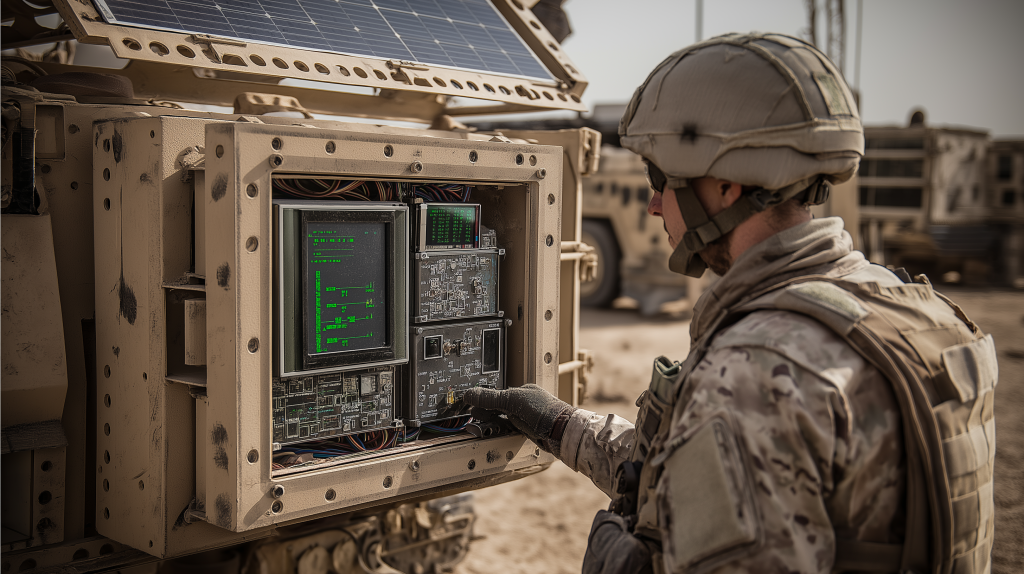
Flexible solar panel technologies enable integration of renewable energy generation directly into military equipment without compromising operational capabilities. Modern high-efficiency photovoltaic cells can be integrated into equipment covers, antenna arrays, and even display bezels to provide supplemental power generation.
Advanced power management systems automatically balance solar generation, battery storage, and load requirements to optimize energy utilization throughout mission cycles. These systems can extend operational endurance significantly while reducing dependence on external power sources.

Power-Aware System Architecture
Energy-efficient HMI design extends beyond individual components to encompass entire system architectures. Power-aware software automatically adjusts system behavior based on available energy reserves, gradually reducing non-essential functions as battery levels decline while maintaining critical capabilities.
Intelligent sleep and wake algorithms ensure that system components consume power only when actively required. Advanced sensors can detect user presence and attention, automatically adjusting system power states to match operational requirements.

Lifecycle Environmental Impact
Sustainable design considerations extend throughout the entire system lifecycle, from material selection through end-of-life disposal. Advanced materials science enables the development of ruggedized components using recyclable materials without compromising performance or durability.
Modular system architectures enable component-level upgrades and repairs, extending overall system lifecycles while reducing waste generation. Standardized interfaces ensure that upgraded components can integrate seamlessly with existing systems, protecting previous investments while incorporating new capabilities.

Thermal Management Efficiency
Efficient thermal management systems reduce cooling power requirements while maintaining optimal component temperatures. Advanced heat sink designs, thermal interface materials, and intelligent fan control systems minimize cooling power consumption while ensuring reliable operation in extreme environments.
Predictive thermal management algorithms anticipate temperature changes based on operational patterns and environmental conditions, preemptively adjusting cooling systems to maintain optimal efficiency.

Mission Endurance Optimization
Power-efficient HMI systems enable extended mission durations without resupply requirements, providing significant tactical advantages in contested environments. Reduced power consumption translates directly to increased operational range and mission flexibility. Intelligent power management systems provide operators with real-time feedback on energy consumption and projected mission endurance, enabling informed decisions about system utilization and mission planning.

The Aeromaoz Sustainability Advantage

Aeromaoz‘s specialized focus on military applications enables us to implement sustainability measures that enhance rather than compromise operational effectiveness. Our deep understanding of military power requirements allows us to optimize energy efficiency without sacrificing the performance and reliability that mission success demands.
Our agile development processes enable rapid incorporation of emerging sustainable technologies while maintaining rigorous military qualification standards. This specialized expertise provides significant advantages in delivering environmentally responsible solutions that meet evolving DoD requirements.
Sustainable defense technology represents both an environmental imperative and an operational advantage. Energy-efficient HMI systems enhance mission capabilities while supporting broader sustainability goals, creating win-win solutions for military effectiveness and environmental stewardship.