
From Cockpit to Combat Boat: How Aerospace HMI Engineering Is Redefining Naval Operator Interfaces
When the IDF Navy commissioned a purpose-built mission grip for its commando assault boats, the brief was demanding: survive the sea, serve the operator and integrate with everything. AEROMAOZ delivered – and in doing so, opened a new chapter for naval HMI.
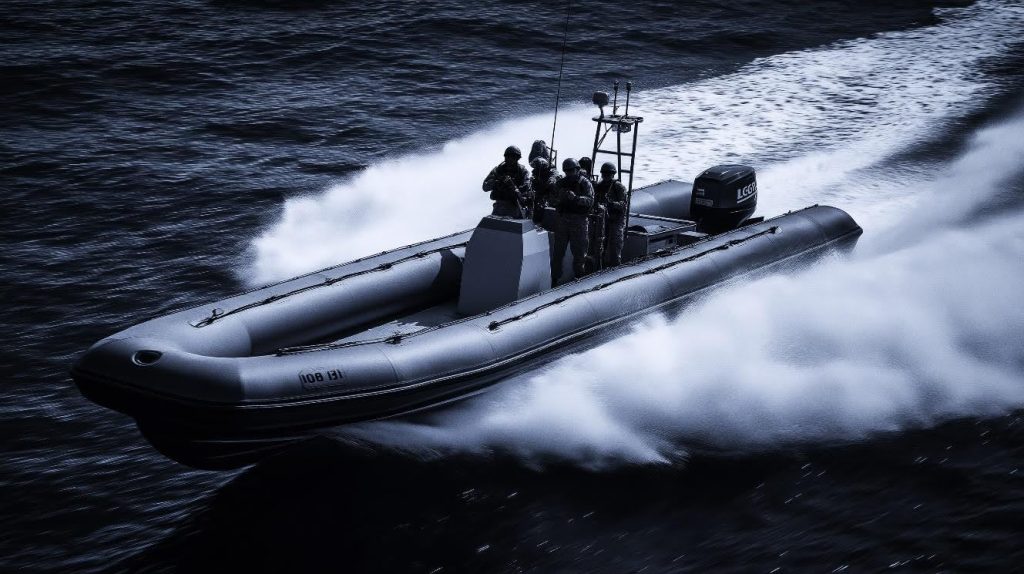
An IDF naval commando RHIB assault boat operating at speed in Mediterranean waters. AEROMAOZ’s mission grip was purpose-engineered to control weapons and visual systems aboard vessels operating in exactly these conditions.
There is a category of engineering problem that resists off-the-shelf solutions. It sits at the intersection of physics, physiology, and operational reality, where ambient vibration never stops, where salt-laden air attacks every connector, where the operator’s hands may be wet and gloved and shaking from adrenaline, and where a control input made a fraction of a second too late can change the outcome of a mission.
Naval commando operations present precisely this challenge. And when the IDF Navy Seals decided to modernize the human-machine interface aboard their RHIB assault boats, they identified a partner whose core competence had been built in an equally unforgiving environment: aerospace.
A Requirement Written in Operational Reality
The operational brief for the IDF Navy Seals control grip was not produced in a procurement office. It was shaped on the water, through dialogue with the operators who live inside these systems. The requirements that emerged were precise and uncompromising:
• Sustained operability through constant vibration, salt spray, and extreme temperature cycling
• Seamless control of both weapons and visual systems from a single interface
• Full NVIS (Night Vision Imaging System) compatibility to support covert night operations
• Ergonomic geometry enabling confident, precise grip for several hours without operator fatigue
• Co-designed with end users at every stage of development – not validated against them after the fact
What these requirements describe is not a joystick. They describe a life-safety system that must perform reliably under conditions few commercial products are designed to encounter.
Three Engineering Disciplines, One Integrated Product
AEROMAOZ’s approach to the IDF Navy Seals grip was defined by integration. Rather than treating mechanical, electrical, and ergonomic design as sequential phases, the development team converged all three disciplines from the outset – allowing trade-offs between sensor placement, structural geometry, and operator comfort to be resolved in real time rather than retrofitted at the end.
The result is a control grip whose features reflect that integrated methodology:
• High-precision sensors delivering accurate input detection under dynamic sea-state conditions
• Configurable button architecture supporting versatile multi-system control from a single grip
• Optional force feedback providing tactile confirmation of inputs during high-intensity operations
• Full NVIS compatibility across all illuminated interface elements
• Contoured, lightweight ergonomic housing designed for extended wear without fatigue, even under physically demanding conditions
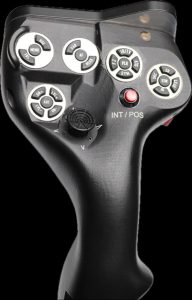
The AEROMAOZ mission grip developed for IDF Navy Seals assault boats, featuring multi-function rocker clusters, INT/POS switching, and full NVIS compatibility.
Critically, the design was refined continuously through direct feedback from IDF Navy Seals operators – not through representative surveys or post-development acceptance testing, but through iterative co-design embedded in the development process itself. The final product reflects actual field requirements rather than interpreted ones.
Why Aerospace Heritage Translates to Naval Performance
The leap from aerospace cockpit to naval combat boat is shorter than it might appear. Both environments impose wide thermal ranges, high mechanical shock and vibration, electromagnetic interference, and operators working under sustained physical and cognitive stress. Both require interfaces that deliver the right input to the right system with zero ambiguity, every time.
With over 45 years of experience designing and manufacturing rugged HMI solutions for military aviation, commercial aviation, armored fighting vehicles, UAV ground control stations, and flight simulation, AEROMAOZ has built its product philosophy around exactly these constraints. Every component in the company’s portfolio – control grips and sticks, rugged display panels and bezels, multi-function keypads, integrated cockpit interface units – is engineered for high-vibration, wide-temperature-range, EMI-dense environments, with full compliance to military and airworthiness certification standards.
AEROMAOZ serves tier-1 system integrators and platform manufacturers including Thales, Honeywell, Elbit Systems, BAE Systems, Boeing, Airbus, and Lockheed Martin. The design principles behind a display bezel that performs reliably in the cockpit of a commercial airliner are directly applicable to a naval vessel bridge system, a coast guard patrol craft, or an offshore platform operator console – and now, proven aboard a special operations assault boat.
A New Domain, A Familiar Methodology
The IDF Navy Seals grip program is, in one sense, a first – AEROMAOZ’s formal entry into the naval domain as a program of record. But in another and more important sense, it is simply another proof point for a methodology the company has applied across every program it has undertaken:
• Deep operator co-design, embedded in the development process from day one
• Multi-disciplinary engineering integration, resolving trade-offs before they become problems
• Uncompromising commitment to in-field performance over lab-compliant specification
For naval procurement offices and system integrators seeking an HMI partner with verified credentials in mission-critical environments – one that brings both aerospace-grade engineering and a proven track record of operator-centered design – this program provides a clear reference point.
AEROMAOZ’s diversified portfolio – spanning panels, displays, bezels, pushbuttons, and control sticks – positions the company as a capable, experienced partner for both defense and commercial naval integrators. The aerospace heritage is intact. The naval capability is now proven.