
Night Operations and NVG Compatibility: The Critical Role of NVIS-Compliant Displays in Armored Vehicles
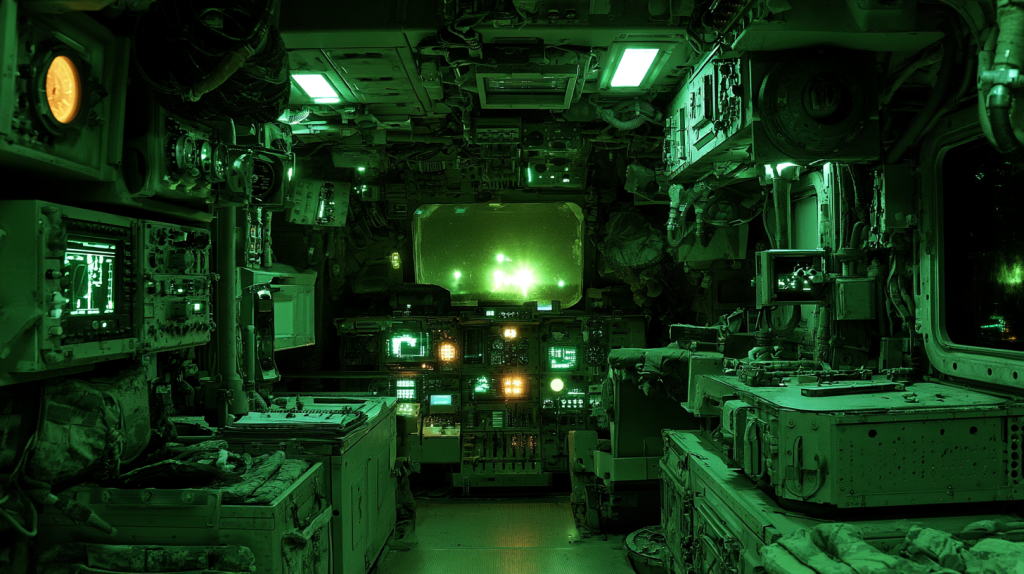
Night operations have always been a decisive domain in armored warfare. Modern combat vehicles now operate extensively under night vision, with crews relying on image intensification and thermal imaging to navigate, acquire targets, and maintain situational awareness in complete darkness. But there is a persistent and often overlooked threat to that capability hiding inside the vehicle itself: the light emitted by crew station displays and control panels.
Why Interior Lighting Threatens Night Vision
Night Vision Imaging Systems (NVIS) work by amplifying available ambient light — starlight, moonlight, or near-infrared illumination. Any direct light source visible to the image intensifier tube will bloom dramatically, temporarily or permanently degrading the crew’s night vision. NVIS-compatible armored vehicle display design addresses this by controlling the spectral content and intensity of all light-emitting components in the crew compartment, ensuring that displays, indicators, and backlit controls do not emit wavelengths that activate the image intensifier.
This is not simply a matter of dimming displays to a low brightness level. Conventional backlights emit across a broad spectrum, including the near-infrared wavelengths most harmful to image intensifiers. A display dimmed to apparently low brightness may still emit significant NVIS-incompatible radiation. Addressing this requires spectral filtering or LED illumination technology specifically designed to avoid problematic wavelengths.
MIL-STD-3009: The Standard That Defines NVIS Compatibility
MIL-STD-3009 ground vehicle display compliance defines three classes of NVIS-compatible lighting, each calibrated to a different operational context:
- Class A: the most stringent, for platforms where crew members are operating NVGs simultaneously with interior controls — typical of rotary wing aircraft and now increasingly specified for armored vehicle crew stations
- Class B: permits somewhat higher NVIS emission, appropriate for environments where NVG use is intermittent or the operator can look away from displays before reacquiring a NVG view
- Class C: the least restrictive, addressing near-infrared emission primarily, for applications where visible light management is less critical
Most modern armored vehicle programs, particularly those designed for peer adversary engagement in contested night environments, specify Class A or Class B compliance for all crew station illuminated components. This includes not just displays but also every illuminated button, switch, knob, and panel in the crew compartment.
The Scope of the Problem: Every Emitting Surface Matters
A comprehensive NVG crew station armored vehicle design must account for every light-emitting element in the crew compartment. A single non-compliant indicator lamp on a secondary control panel can compromise the NVIS compatibility of the entire crew station. This systemic requirement creates both a design challenge and a procurement challenge: all illuminated components must be sourced from suppliers with active MIL-STD-3009 qualification.
The scope includes: primary and secondary displays, backlighting for all labeled panels and control assemblies, indicator lamps and status lights, illuminated push-button switches, rotary control knob lighting, and any other source of interior illumination. Managing this scope requires either a single integrated supplier capable of delivering the full complement of NVIS-compliant components, or rigorous compatibility testing of components from multiple sources.
Leveraging Aviation NVIS Experience in Ground Vehicle Applications
The aviation industry has navigated these requirements for decades. Military helicopter cockpits and fixed-wing crew stations have long demanded NVIS compatibility across every illuminated element, driving a mature ecosystem of qualified components and deep supplier expertise. That expertise transfers directly to the ground vehicle domain, where the physics of image intensification are identical even if the platform geometries differ.
Suppliers with active NVIS aviation display qualification programs are uniquely positioned to serve armored vehicle programs. Their designs are already proven against the most demanding NVIS specifications, their qualification documentation is current, and their engineering teams have solved the spectral management problems that NVIS compliance requires.
AEROMAOZ: NVIS Compliance Across Platforms
AEROMAOZ has qualified products to MIL-STD-3009 across a range of aviation and ground vehicle platforms. The company’s display panels, illuminated bezels, push-button switches, and control knobs are available in NVIS-compatible configurations, with qualification documentation supporting program integration. For armored vehicle programs that cannot afford NVIS compromises — which is all of them — AEROMAOZ offers a proven, single-source capability.
Contact AEROMAOZ to discuss NVIS-compliant crew station solutions for your platform.