
Human-Machine Integration in the Age of Autonomous Ground Vehicles: The HMI Supervisor’s Role
The introduction of unmanned ground vehicles and semi-autonomous platforms onto the modern battlefield is transforming what it means to operate an armored vehicle. The crew member is no longer just a driver or gunner – increasingly, the crew member is a supervisor, managing a constellation of robotic systems through interfaces that must be intuitive, reliable, and fast enough to support split-second tactical decisions.
From Operator to Supervisor
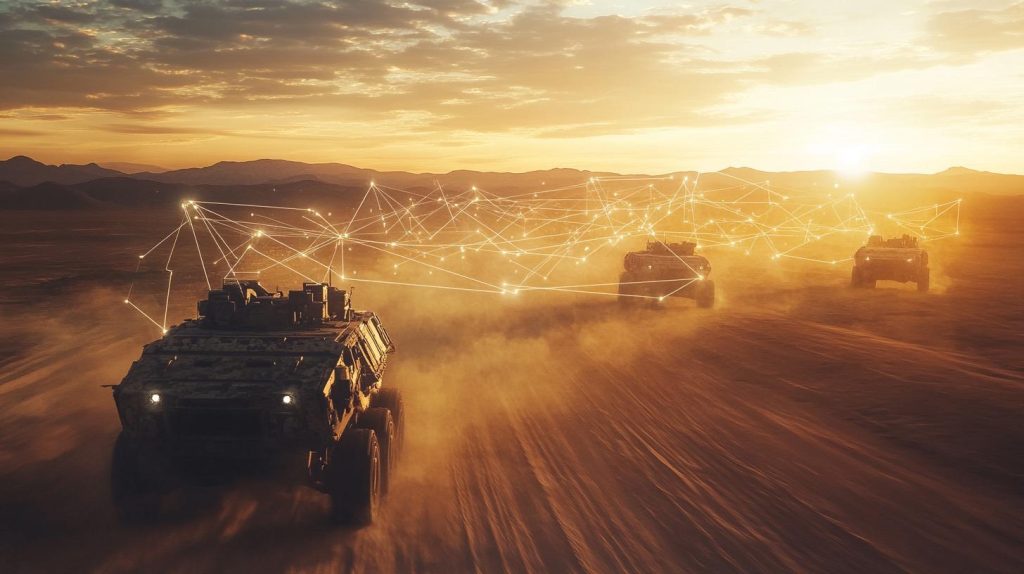
The U.S. Army’s Human-Machine Integration Formations (HMIF) represent the leading edge of this transition. The concept calls for UGV human machine interface systems that allow small units to deploy unmanned ground vehicles for high-risk tasks including over watch, route clearance, and direct fire support – tasks previously requiring soldiers in exposed positions. The explicit goal articulated by Army leadership is “no blood for first contact,” where human-machine integrated formations absorb the risks of initial engagement while human crews direct operations from protected positions.
This shift fundamentally changes HMI design requirements. Where a traditional tank commander interface was optimized for controlling one vehicle with direct physical feedback, the supervisory interface must present the status of multiple autonomous platforms simultaneously, with clear prioritization of alerts and a control logic that allows rapid intervention when autonomous behavior needs override.
The Interface Challenge: Complexity Without Clutter
Designing autonomous ground vehicle HMI for supervisory control requires resolving a fundamental tension: the operator needs access to more information than ever before, but cognitive load must be lower, not higher. The interface must surface the right information at the right moment — hiding routine telemetry when everything is normal, escalating critical alerts without creating alarm fatigue.
This demands a departure from traditional fixed-layout displays. Adaptive interface architectures that reconfigure based on mission phase, threat level, and platform state are increasingly the standard in next-generation programs. The display is no longer a passive readout; it is an active participant in crew decision-making.
Physical Controls in a Semi-Autonomous World
Even as software defines more of the interface, robotic combat vehicle controls still require robust physical inputs. In high-vibration environments, gloved hands, and degraded visibility conditions, a touchscreen alone is insufficient for mission-critical commands. Joysticks, grip controllers, push-button panels with tactile feedback, and illuminated knobs all retain a critical role in the supervisory control architecture.
The design challenge is integrating physical controls with software-defined displays in a coherent crew station that allows operators to transition fluidly between direct control of the host vehicle and supervisory management of accompanying unmanned systems. This requires careful attention to control placement, force feedback, and the physical affordances that allow operators to act by feel rather than sight.
Latency and Reliability: The Non-Negotiables
Human-in-the-loop defense HMI for autonomous platforms imposes stringent requirements on interface latency and reliability. A delay of even a fraction of a second in transmitting a stop command to an autonomous vehicle moving toward a civilian area can have catastrophic consequences. HMI components in this application are not peripheral equipment — they are safety-critical elements whose failure modes must be defined, tested, and qualified with the same rigor applied to weapons systems.
Qualification frameworks including MIL-STD-810 for environmental resilience and DO-160 for electrical and mechanical performance provide the baseline. Suppliers with active qualification programs across both ground and aviation platforms bring exactly the cross-domain experience that supervisory HMI development requires.
Lessons from Aviation: AEROMAOZ’s Cross-Domain Advantage
The challenges of autonomous platform HMI design in ground vehicles closely parallel challenges already solved in military aviation. Managing multiple UAVs from a ground control station, coordinating crew workload in a two-seat attack helicopter, and transitioning between automated and manual flight modes all require the same design principles now being applied to armored vehicle programs.
AEROMAOZ has built its product range around exactly these challenges — ruggedized displays, illuminated control panels, joystick and grip assemblies, and push-button switch arrays, all qualified to the most demanding military standards. That experience translates directly to the emerging requirements of human-machine integration in the ground domain.
Explore AEROMAOZ’s HMI product range at aeromaoz.com.